

Gouda cheese
Gouda cheese is a cow’s milk cheese that can be mild and soft or firm and strongly flavoured, depending on its age. Order a selection to taste how much a few months of maturing can change this Dutch cheese.
What it is
For Gouda Holland, makers pasteurise Dutch cow’s milk and curdle it. They wash the curds, press them into shape and put the cheese in brine, or salty water. It then matures naturally and is turned regularly as a rind forms. Age makes a big difference. In Kaas.nl’s guide, ‘jong’ means about one month old, ‘belegen’ four months and ‘oud’ ten months. ‘Overjarig’ means a year or older. Longer-matured cheese becomes firmer, drier and stronger in flavour.
Where it comes from
Gouda takes its name from the cheese market in the town of Gouda. In 1395, the town gained a monopoly on selling cheese in the county of Holland. Trading became concentrated on its Marktveld around 1500. By 1697, a hefty 1.75 million kilograms of cheese were being traded there. The name points to a trading centre, rather than meaning that every cheese called Gouda comes from the town.
How to eat it
For breakfast or lunch, a ‘broodje kaas’ is the Dutch cheese-sandwich choice. For a selection of Gouda cheeses, look for ‘kaasplank’ on a menu. As one dated example, Café De Goudse Eend listed Gouda cheeses with homemade bread and mustard-dill sauce for €15.50 in 2025. That is one menu price, not a general price guide.
How to spot a good one
Choose the age that suits you, rather than assuming older is better. Young Gouda is mild and soft; aged Gouda has a firmer bite and stronger flavour. For verified Dutch origin, look for the protected name ‘Gouda Holland’. It must use Dutch cow’s milk and mature in the Netherlands, though that does not guarantee you will prefer its taste. Noord-Hollandse Gouda uses milk from North Holland and is less salty than other Gouda cheeses. Its rules also allow cumin.
When to have it
A cheese sandwich fits breakfast or lunch. For a seasonal version, look for Boeren-Goudse Oplegkaas. It is made on farms from raw summer milk while cows graze in the Green Heart’s peat meadows. Slow Food says it matures for at least two years and up to four, so summer describes the milk, not a cheese to eat straight away.
Worth knowing
Gouda’s Waag, or weighing house, was built by Pieter Post in 1668 to replace an older one. The summer cheese market still recalls the old trade, with prices negotiated through ‘handjeklap’, a hand-clapping ritual, and cheese weighed in the Waag.
Sources
- European Commission ([agriculture.ec.europa.eu](https://agriculture.ec.europa.eu/farming/geographical-indications-and-quality-schemes/geographical-indications-food-and-drink/gouda-holland-pgi-noord-hollandse-gouda-pdo_en))
- Historische Vereniging Die Goude, 2026 ([diegoude.nl](https://www.diegoude.nl/publicaties/oud-gouda/ontstaan-goudse-kaasmarkt/))
- Café De Goudse Eend, 2025 ([cafedegoudseeend.nl](https://cafedegoudseeend.nl/eten/))
- Official Journal of the European Union, 2010 ([eur-lex.europa.eu](https://eur-lex.europa.eu/eli/reg/2010/1122/oj/eng/pdf))
- Kaas.nl, 2019 ([kaas.nl](https://www.kaas.nl/de-rotterdamsche-oude-wat-tijd-doet-met-kaas/))
- Official Journal of the European Union, 2024 ([eur-lex.europa.eu](https://eur-lex.europa.eu/legal-content/EN/TXT/PDF/?uri=OJ%3AC_202403414))
- Slow Food Foundation ([fondazioneslowfood.com](https://www.fondazioneslowfood.com/en/slow-food-presidia/aged-artisanal-gouda/))
Where to eat it in Amsterdam
De Kaaskamer
Runstraat, the Nine Streets

Noordermarkt
Farm cheeses on Saturday
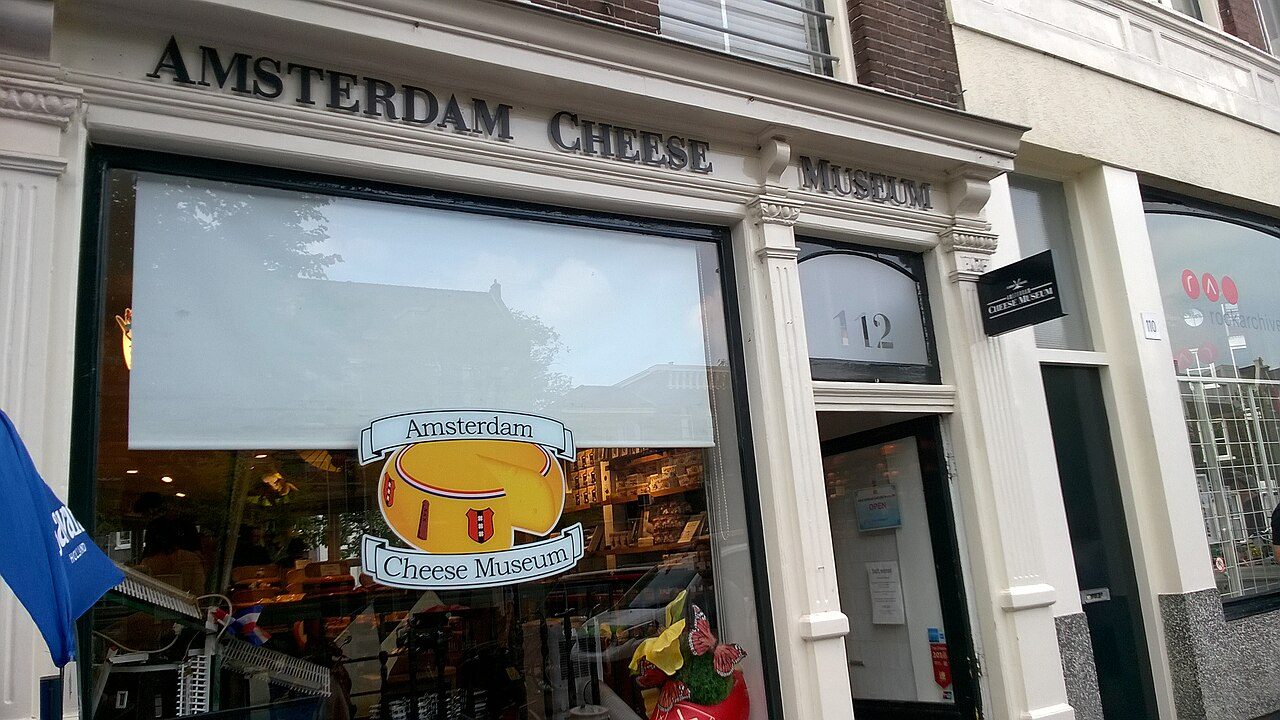
Cheese Museum (Henri Willig)
Prinsengracht
Next on your passport
All 15 › Fish · €3–6
Dutch herring
Dutch herring is salted, ripened fish with a creamy texture and a lightly salty taste. Order it for a Dutch food tradition that comes with a choice: bite-sized pieces, a sandwich, or the head-back, tail-in-hand approach.
Where to eat it ›
 Snack · €6–9 for 6–8
Bitterballen
Bitterballen are fried balls of thick meat ragout, with a crunchy breadcrumb shell and a soft centre. Order a portion with mustard for a Dutch drinks snack that is small enough to share but hot enough to demand patience.
Where to eat it ›
 Sweet · €2–4
Stroopwafel
A stroopwafel is a thin waffle split in two and filled with sweet, buttery syrup. Order one freshly baked for the pleasure of crisp wafer and warm, soft filling.
Where to eat it ›
 Dutch-Indonesian · €18.82 average for chicken satay in 2024
Satay
Satay is meat grilled on skewers, commonly served in the Netherlands with thick brown peanut sauce. Order it for browned bites from the grill and a generous helping of sweet, nutty sauce.
Where to eat it ›