
CASTLE
Kasteel Heeswijk
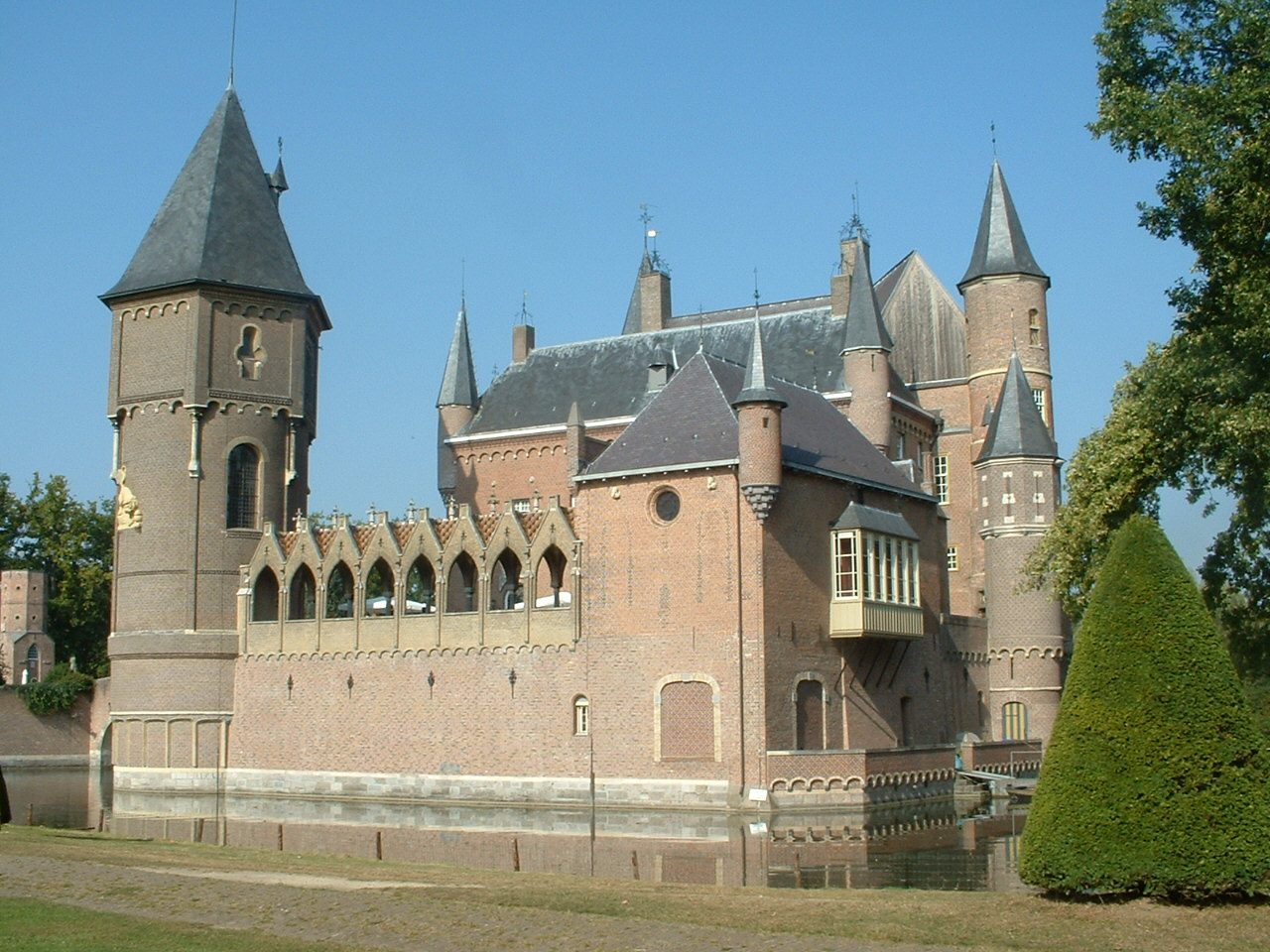
A moated castle near Heeswijk, with towers, water and museum rooms shaped by nineteenth-century collectors. Its interiors hold carved wood, paintings and reused objects.
A castle behind the moat
Kasteel Heeswijk is a former moated stronghold near Heeswijk in Noord-Brabant, now a castle museum with rooms shaped by nineteenth-century collectors. In 1672, Louis XIV stayed here during his campaign against the Dutch Republic. The French king occupied the Pewter Room. Look closely at its wood panelling: a concealed door leads to a medieval toilet. It is a small, practical detail in a room associated with a king.
The castle rewards looking at both scales: the towers and water outside, then the furniture, carved wood and reused objects within. What you see is not an unchanged medieval fortress. It is a building repeatedly adapted for defence, country-house life and the display of an ambitious family's collection.
From stronghold to country house
A predecessor stood here around 1080: a motte castle built on a mound. During the Middle Ages, the mound was levelled and a castle took its place. Its position near the River Aa mattered. Boats travelling from the Peel towards ’s-Hertogenbosch passed this way.
Count Johan Cirksena of East Frisia built a brick outer bailey with pale stone bands. Its west and south wings survive. Look for that striped masonry as you approach. Around 1600, Prince Maurice twice failed to capture Heeswijk. His half-brother Frederick Henry succeeded in 1629, before besieging ’s-Hertogenbosch. After Louis XIV's arrival in 1672, the defences were destroyed and the castle became a country house.
In 1835, Governor André van den Bogaerde van Terbrugge bought the deteriorating property. His rebuilding gave it a neo-Gothic castle form and space for paintings, medieval sculpture, art objects and curiosities.
An altar too large for the rooms
André's sons Louis and Alberic expanded the collection. The Armoury and Iron Tower were added to accommodate it. In the nineteenth century, Jonker Louis bought the enormous baroque high altar from St John's Cathedral in Den Bosch. No room in the castle was large enough to hold it.
Instead, parts of the altar were incorporated into the Armoury, while four columns became garden benches. Two missing altar angels resurfaced in Belgium in 2007. Keep that dismantled altar in mind when looking at the interiors: not everything began life as castle decoration.
Collecting also shaped the family's unusual living arrangements. When Donatus van den Bogaerde died in 1895, his will prohibited anyone from living in the castle until 1963, an attempt to preserve the art collection together. It did not work as intended: much of the collection was sold through ten auctions from 1899. In 1949, his heir Baron Andreas and his wife moved into the coach house instead.
The water and the avenue
The moat has a wartime story as well as a defensive purpose. On 17 September 1944, American paratroopers missed their intended landing zone and came down around the castle. Chaplain Captain Sampson landed in the moat. He pulled another parachutist from the water by his parachute.
Even the approach has yielded unexpected evidence of the past. In 2017, two cannons were rediscovered in the vegetable garden. Local resident Johan de Visser recalled them standing on either side of the castle avenue. He said they had been dumped in the garden during road construction, with their ends painted white to mark the road.
Pause by the water and look back towards the buildings. The moat, outer bailey and later towers belong to different chapters of the same place.
Things to know
- Head for Heeswijk in Noord-Brabant; the castle stands nearby.
- Allow time for both the museum rooms and the exterior.
- Wear comfortable shoes for looking around the castle grounds.
- In the Pewter Room, look closely at the wood panelling.
- Opening hours and prices can change. Check the official website before you go. Official website