
CASTLE
Slot Moermond
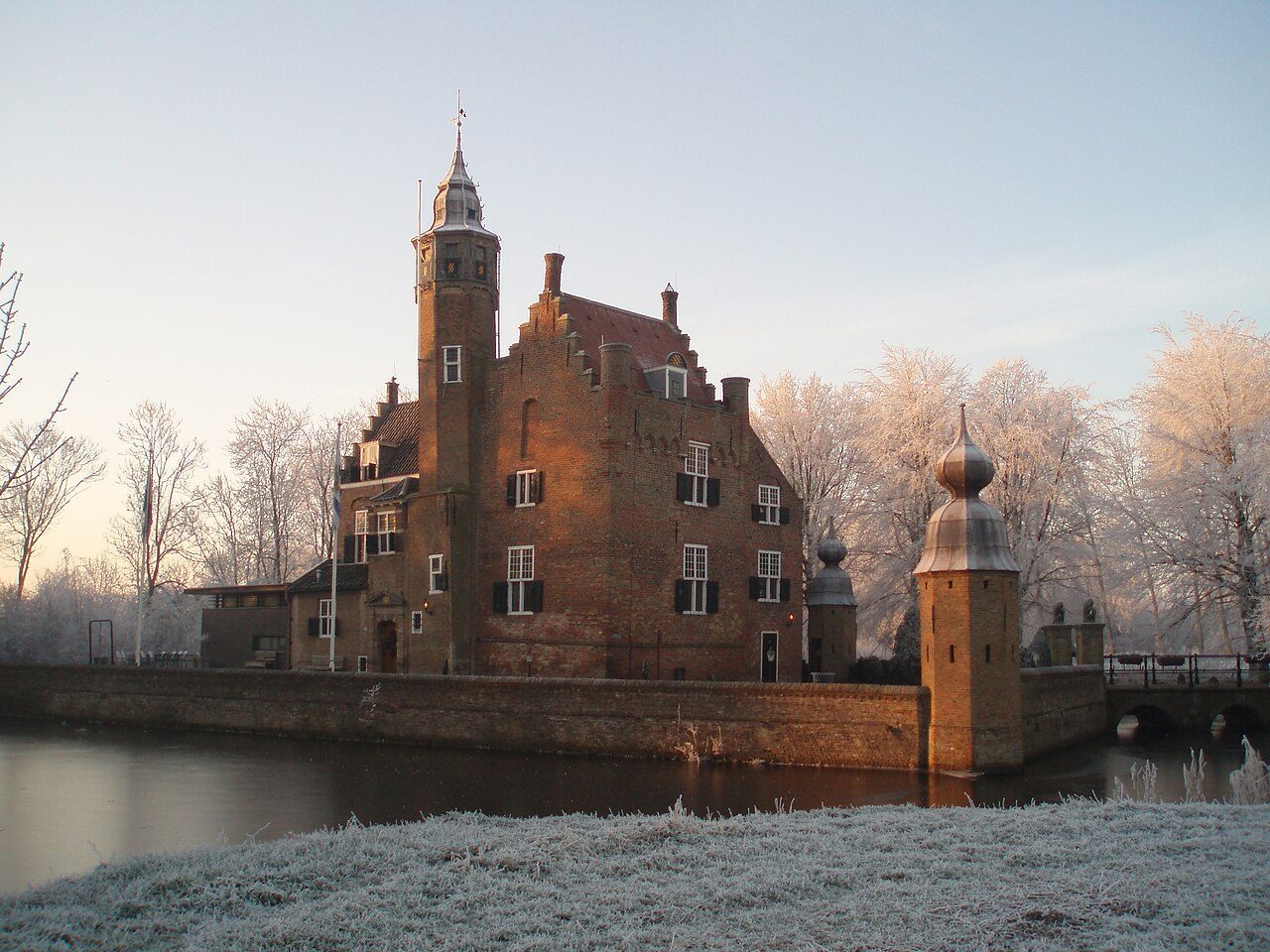
A moated brick castle in Renesse, with a square main building shaped by repeated rebuilding. Come for the exterior and the view across the moat.
A castle across the moat
Slot Moermond is a moated brick castle in Renesse, on Schouwen-Duiveland. Its square main building brings together several periods of rebuilding. Above the gateway is a Latin motto placed there in 1613, during Iman van Zuidland’s expansion: “Virtus post fata virescit”—virtue is strengthened by adversity. With sieges, wartime killings and flood damage in its history, the words carry particular weight here.
Come for the exterior and the view across the moat. Look at the relationship between the square building, its tower and the later additions. This is not an untouched medieval castle. The building has repeatedly been adapted, and the contrast between old brickwork and newer construction is part of what you are looking at.
Three castles, one site
The first castle was built for Costijn van Zierikzee between 1229 and 1244. In 1297, Wolfert van Borssele besieged Jan van Renesse and his men at Moermond. Jan escaped, but the castle was destroyed. A local legend gives the site an underground passage leading to De Helle farm, with golden statues of the twelve apostles. When Eilanden-Nieuws retold the story in 1977, it noted that neither the passage nor the statues had been found.
A second castle, probably built before 1339 for Aernoud van Haamstede, was lost in 1454 apart from its gatehouse. That surviving gatehouse became a residential tower in the third castle, rebuilt in 1513 beside the foundations of the first.
An inscription above an upstairs fireplace credits Adriana van Wissekerke, wife of Jacob van Tuyll, with providing the wealth that made the 1513 rebuilding possible. It is a useful reminder that the castle’s history belongs not only to the men whose names appear in accounts of ownership and warfare. The inscription is an interior detail, rather than something to expect to see on an exterior walk.
The stone by the driveway
The approach has a much more recent and painful history. At noon on Sunday 10 December 1944, the German Wehrmacht hanged nine resistance fighters from the group known as the Ten of Renesse at the gate to the castle driveway.
Jan Andreas Verhoeff was among those killed. The account recalled in the Zierikzeesche Nieuwsbode in 1988 connects the executions with a failed escape attempt. A memorial boulder now marks the execution site. Pause here before concentrating on the castle: the driveway is also a place of remembrance.
What the flood left behind
During the 1953 North Sea flood, deep water stood in and around the Vriesendorp family’s castle for months, causing extensive damage. Later, work to deepen the moat uncovered masonry that led to the discovery of part of the first castle’s ring wall.
Restoration brought new uses, first as a training institute and then as a conference venue. Today the castle serves as a restaurant and conference centre. A late-20th-century rear addition differs sharply from the older building, and almost all the historic interior has been lost. From outside, concentrate on what remains legible: the moat, the square brick mass and the gatehouse incorporated into a later home.
Things to know
- Approach on foot from Renesse for the castle exterior.
- Go in daylight to see the brickwork and gateway.
- Look for the memorial boulder by the driveway gate.
- Plan an exterior visit; do not assume the upstairs fireplace is accessible.
- Opening hours and prices can change. Check the official website before you go. Official website