
CASTLE
Kasteel van Breda
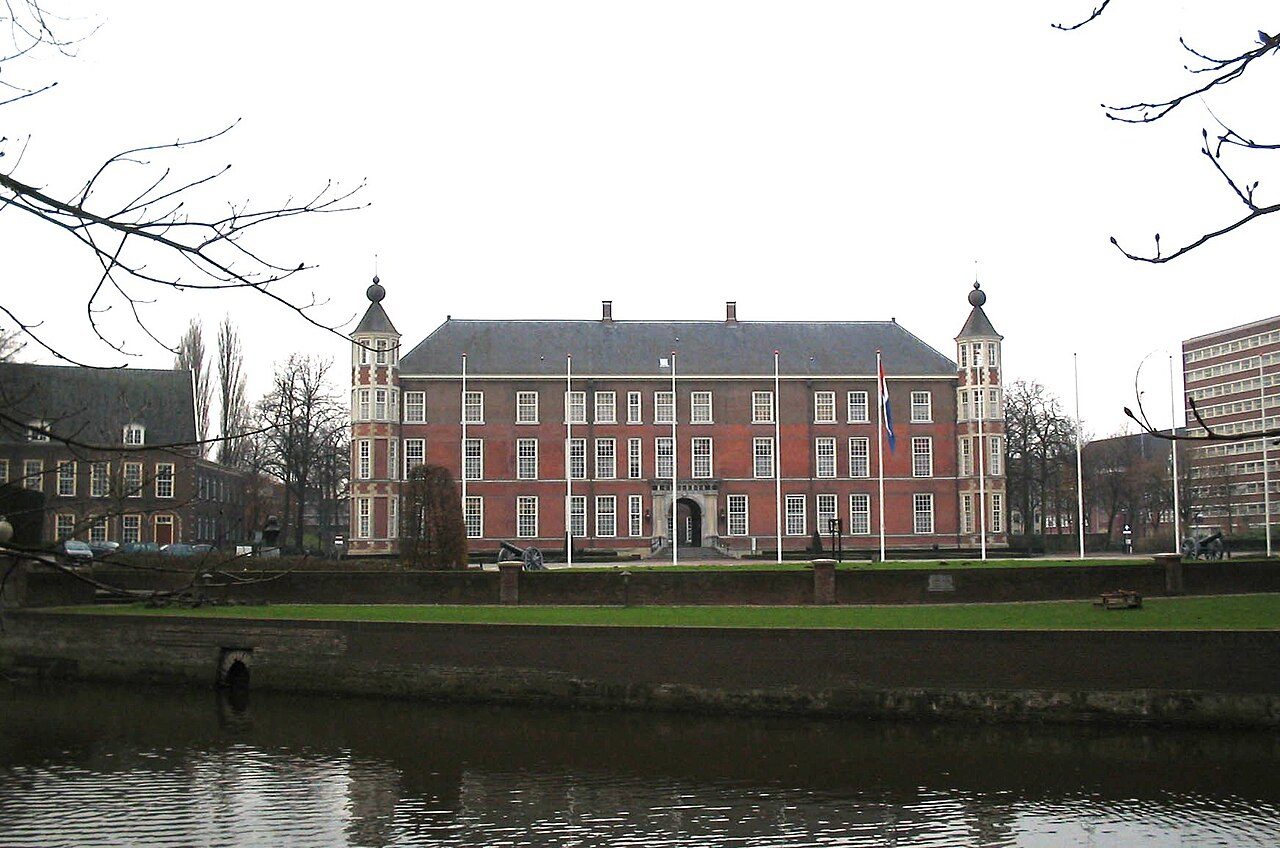
Kasteel van Breda is a former Nassau residence that now houses the Royal Military Academy. Its waterside towers and arched water gate recall the old fortifications.
A castle taken by a peat boat
Kasteel van Breda is a former Nassau residence that now houses the Royal Military Academy. In 1590, Charles de Héraugière and 75 soldiers hid beneath peat aboard a barge associated with skipper Adriaan van Bergen. Around midnight, they emerged and captured the castle from its garrison. The victorious boat was kept on display in the castle grounds until 1625.
That story gives the waterside walls a different scale. This was both a princely home and a place that could decide control of Breda. Walk towards the castle at Kasteelplein, in the centre of the city, then look at its relationship with the surrounding water. Much of the original defensive system has disappeared, but the surviving towers still make its purpose clear.
From fortress to Nassau palace
In 1353, Jan II van Polanen bought Breda from the Duke of Brabant and strengthened the castle with a moat and four corner towers. His granddaughter Johanna van Polanen married Engelbrecht I of Nassau-Siegen in 1403. Through that marriage, Breda and its castle passed to the Nassau family, beginning the connection between the Netherlands and the House of Orange-Nassau.
The building changed with its owners’ ambitions. Johan IV enlarged it shortly after 1460; the surviving Nassautoren belongs to this period. Hendrik III began turning the castle into a Renaissance palace in 1536. After his death in 1538, his son René van Chalon continued the work and built the court chapel in 1540. William of Orange later inherited the castle as an eleven-year-old.
Diplomacy followed warfare here. In 1667, representatives of England, the Dutch Republic and France signed the Treaty of Breda in the castle, ending the Second Anglo-Dutch War.
Look closely at the water gate
The Spanjaardsgat is the arched water gate between the castle’s two waterside towers. These seven-sided towers are the clearest surviving pieces of the old fortifications. Pause where you can take in both towers and the opening between them, rather than looking only at the palace buildings.
The arch is often attached to the peat-boat story, but the dates rule that out. The Spanjaardsgat was built in 1610, twenty years after the attack. The boat entered farther north. It is a useful correction to keep in mind while standing beside the water.
Archaeology has supplied less visible details. In 1992, an excavation involving archaeologist Theo de Jong uncovered kitchen waste from the Nassau household dating to 1525–1540. Among swan and fish bones was a turkey bone, a rarity in Europe then. Another discovery that year was an unidentified man’s skeleton behind the castle. Cadets slipped out at night to photograph it. De Jong and investigators dated the burial to around 1830–1850, but the man’s identity remained unknown.
A working academy
King Willem I made the castle available to the Royal Military Academy in 1826, and the first cadets arrived in 1828. It remains an academy rather than a castle you can simply wander into. Guided visits offer exceptions to the normal restriction on public access.
Its military life includes a lighter ritual. During the renovated castle’s reopening in 2022, King Willem-Alexander unveiled a painting in the Henricuspoort with cadet Leon van der Velden. The cadet promptly tilted it crooked. The king laughed and straightened it, joining a tradition in which cadets tilt the picture and officers put it right. Behind the formal gates, the castle is still a place with its own everyday customs.
Things to know
- Head to Kasteelplein in central Breda.
- Allow time to view the waterside towers and Spanjaardsgat.
- Choose daylight for a closer look at the masonry.
- For an interior visit, ask the local tourist office about guided tours; ordinary walk-in access is not available.