
CASTLE
Kasteel Het Oude Loo
A 15th-century brick hunting lodge surrounded by a moat, with a garden accessible in April and May, a beech maze and a statue pond.
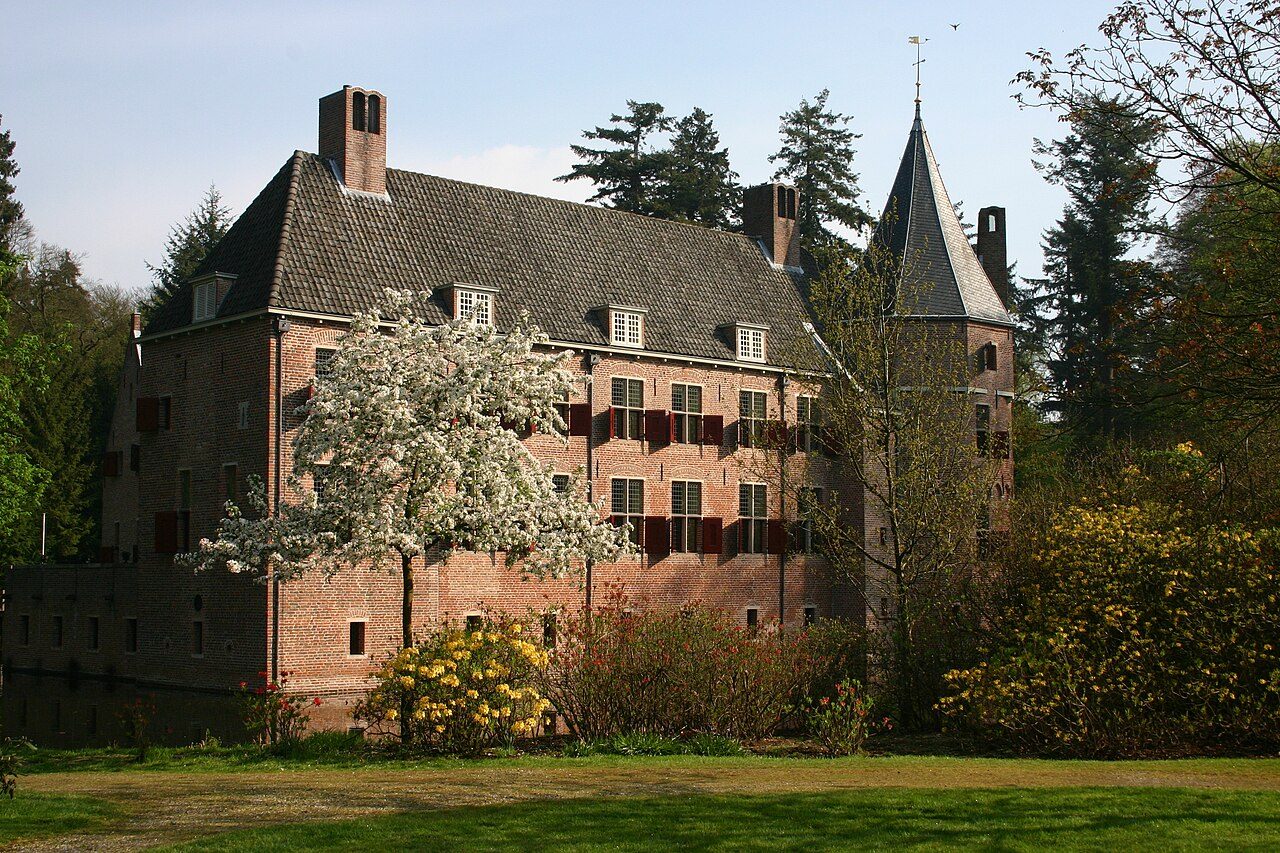
The castle with the returning moat
Kasteel Het Oude Loo is a 15th-century brick hunting lodge surrounded by a moat on the Het Loo estate in Apeldoorn. In the early 1800s, King Louis Napoleon had that moat filled in, reportedly because someone had foretold that he would drown. A century later, Queen Wilhelmina took up a spade herself to begin uncovering it again. The water around the castle is part of a restoration, not an unbroken medieval survival.
The castle remains a country house and guest residence for the Dutch royal family. You cannot visit its rooms, but the garden is accessible in April and May. That makes this a seasonal walk for the castle exterior, its water and the smaller buildings around it.
Older than the palace
The estate first appears in records in 1439 as the property of Udo Talholt, an adviser to the Duke of Guelders. The oldest parts of the castle date from the 15th century. Look for the front wing with its two round corner towers. Wings added around the middle of the 16th century extended the building around a courtyard. Most of what you see is brick, with relatively little natural stone.
William III of Orange bought the house and land on 27 November 1684. The castle was too small for his household, so he had Het Loo Palace built on the estate.
Queen Wilhelmina commissioned Pierre Cuypers to restore the castle in 1904. He restored the moat but also freely altered the building. Another restoration, begun by Kees Royaards in 1968 and completed by Johannes Bernardus van Asbeck in 1976, reversed many of those changes. Its medieval appearance has been shaped by several generations.
A princess’s kitchen and a travelling pavilion
The wooden chalet beside the castle began as a first-birthday present for Princess Wilhelmina in 1881. Finished in 1882, it gave her a place to play and learn to cook. Animals were kept nearby, including her donkey, Grisette. It is a small, domestic counterpoint to the towers and moat: a royal child’s world beside the family residence.
The surviving white garden pavilion has an older story. In 1768, Princess Wilhelmina of Prussia had two pavilions altered with pagoda-like turrets and glass bells. The white survivor was eventually moved to the pond by the castle. Keep the two Wilhelminas distinct: the princess who changed the pavilions lived long before the queen who restored the moat.
A residence with a recent history
Between 1951 and 1957, Queen Juliana attended spiritual conferences here with the circle around faith healer Greet Hofmans. Hofmans’s influence also caused serious strain in Juliana’s marriage. Behind the hunting-lodge exterior, the castle was a setting for a difficult chapter in royal family life.
In 2022, King Willem-Alexander made Het Oude Loo available to people fleeing Russia’s invasion of Ukraine. When the residents left in January 2023, they planted a tree beside the castle in thanks. A plaque records the gift from the Ukrainian guests of 2022.
The garden also contains a statue pond, a beech maze and an outdoor bowling alley. Give these smaller features time rather than treating the grounds only as a viewpoint for the castle. The pavilion, chalet and planted memorial each belong to a different chapter of life around the moat.
Things to know
- Head to the Het Loo estate in Apeldoorn.
- Plan for April or May, when the castle garden is accessible.
- The castle interior is not open to the public.
- Wear comfortable shoes for a garden walk.
- Allow time for the beech maze and pond.
- Opening hours and prices can change. Check the official website before you go. Official website